
The False Choice Most Entrepreneurs Are Tired of Making
Somewhere along the way, too many purpose-driven entrepreneurs who set out to build a business with a purpose were handed a quiet ultimatum.
You can do work that matters, or you can build a business that makes money.
Not both.
The effect was trying to make peace with the trade-off. You downplay your ambition. You underprice your work. You tell yourself impact is enough, even when the stress of inconsistent revenue keeps you up at night.
But know that wanting purpose and profit doesn’t make you unrealistic. It makes you honest.
At Shift/Co, we work with conscious entrepreneurs who aren’t confused about why they’re building their business. They’re confused about how to grow it without compromising what they care about.
And that confusion isn’t a personal failure. It’s the result of being taught the wrong framework.
As Shift/Co CEO Terri Maxwell says often, “The biggest shift I had to make was realizing there wasn’t an ‘or’ here. There’s an ‘and.’”
This article is about that “and.”
Why Purpose-Driven Businesses Struggle to Grow (And It’s Not What You Think)
Most businesses with a purpose don’t fail because the mission is flawed.
They struggle because the founder assumes meaning or purpose alone will do the heavy lifting.
There’s an unspoken belief that if the work truly matters, people will just find it. That growth should feel organic. That selling should feel unnecessary.
But a conscious business still operates inside real markets, real attention spans, and real financial constraints.
Terri learned this the hard way after leaving a highly successful traditional business behind to build something meaningful.
“I thought there was an ‘or’—I could have purpose, or I could have profit. And that belief is why I failed.”
Purpose doesn’t replace strategy. It demands it.
Growth isn’t a betrayal of your values. It’s how your values reach more people.
From ‘Purpose or Profit’ to ‘Purpose and Profit’
The most dangerous belief conscious entrepreneurs carry is that money somehow dilutes meaning.
That belief shows up as hesitation:
- Hesitating to charge what the work is worth
- Hesitating to market consistently
- Hesitating to ask for the sale
Terri reframes this simply: “Profit is the tip your customers give you when you serve them well.”
A business with a purpose that doesn’t generate profit will eventually lose its ability to serve anyone, including the founder.
Purpose and profit don’t compete. They reinforce each other.
Profit creates stability.
Stability creates longevity.
Longevity creates impact.
This is what Shift/Co calls meaningful money—revenue that comes from real value, delivered sustainably, without disconnecting from your ethics.
“There was part of me that believed business was about greed and selfishness,” Terri Maxwell has shared.
She later had to challenge that belief, realizing that profit isn’t the opposite of purpose—it’s what allows purposeful work to last.
What Actually Makes a Conscious Business Grow
This is where things get practical for real-world execution.
A. Value Comes Before Visibility
Just because your work matters to you doesn’t mean the market understands it.
Growth starts when you clearly articulate:
- Who you serve
- What problem you solve
- Why your solution is worth paying for
Terri puts it bluntly: “People don’t buy your purpose. They buy the solution to their problem.”
Purpose fuels the work. Value sells it.
This is where conscious business coaching becomes essential—not to change your mission, but to help you translate it.
B. Growth Is a Skill, Not a Personality Trait
Many purpose-driven founders secretly believe they’re “just not good at business.”
That belief keeps them stuck.
Demand generation, messaging, and sales aren’t personality flaws—they’re learnable skills.
A conscious business still needs people to know it exists. It still needs demand.
As Terri teaches, “It’s still a business. It just matters more.”
C. Focus Beats Passion Every Time
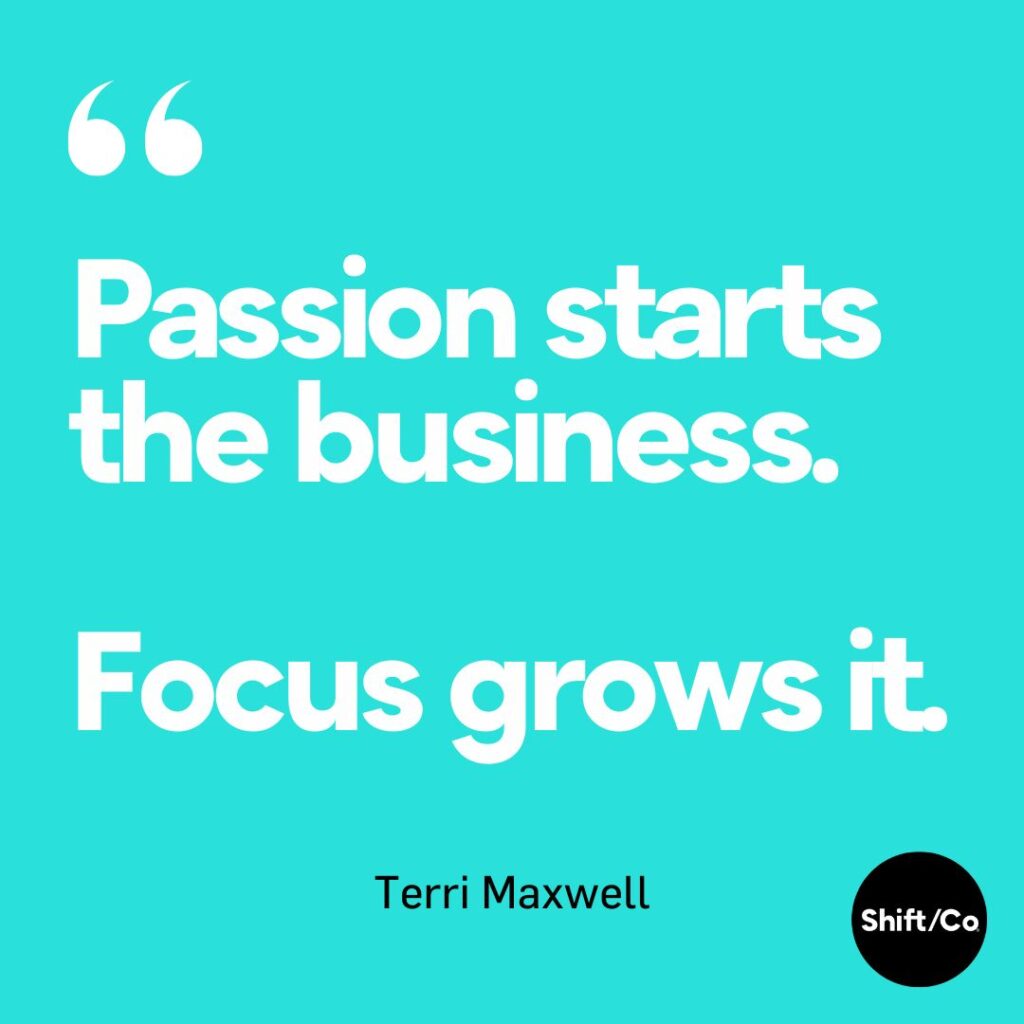
Passion starts the business. Focus grows it.
Most entrepreneurs who feel stuck aren’t lazy. They’re pulled in too many directions—doing a lot, but not actually moving the business forward.
Real growth comes from deliberate action:
- Knowing what to focus on now
- Letting go of what doesn’t matter yet
- Measuring moves, not motion
This is where many conscious entrepreneurs need structure—not pressure.
Terri often reminds entrepreneurs that being stuck isn’t about capability, it’s about focus.
Growth doesn’t come from more effort alone, but from clarity and deliberate action.
The Part No One Wants to Talk About—You Have to Grow Too
Here’s the uncomfortable truth for some:
Your business won’t grow past the beliefs you haven’t examined.
Terri names this clearly: “The business grows as we evolve.”
For conscious entrepreneurs, this often means facing:
- Self-worth tied to money
- Fear of being visible
- Resistance to structure
- Old stories about greed and success
It’s leadership development.
A purpose-driven business asks more of its founder, not less. Self-growth is a journey one must go through.
What Most Conscious Entrepreneurs Get Wrong About Profit
One of the quiet traps purpose-driven founders fall into is treating profit like a personal reward instead of a business requirement.
Profit isn’t what you earn after the work is done. It’s what allows the work to continue.
Terri often reframes this for founders who feel conflicted about money. A business has to be profitable to last. Without profit, even the most meaningful work becomes fragile—and fragile businesses can’t sustain long-term impact.
When profit is optional, everything else becomes optional too:
- Your ability to reinvest
- Your energy and focus
- Your resilience during hard seasons
A conscious business that’s barely surviving doesn’t inspire trust—no matter how meaningful the mission.
This is why Shift/Co emphasizes profitability early. Not as a finish line, but as infrastructure. When the business is financially stable, the founder can think clearly, lead confidently, and make decisions aligned with their values instead of their fears.
Profit doesn’t pull you away from purpose. It gives you room to practice it.
Why Community and Mentorship Change Everything
Trying to build a conscious business alone is exhausting. Most founders don’t need more information.
They need reflection, accountability, and guidance from people who understand the ‘and’.
This is why conscious business coaching works best inside a community:
- You see what’s possible
- You normalize the hard parts
- You stop questioning whether you’re “doing it wrong”
Growth accelerates when you’re no longer isolated.

Conscious Growth Requires a Different Kind of Discipline
One of the biggest misconceptions about conscious entrepreneurship is that it should feel softer.
More intuitive. More free-flowing. Less structured.
But in reality, conscious businesses require more discipline, not less.
Terri talks often about focus as a leadership skill: “Most entrepreneurs are in motion, not making moves.”
Being busy isn’t the same as building momentum.
Conscious growth asks you to:
- Choose one priority instead of chasing ten ideas
- Practice consistency when motivation fades
- Build habits that support growth, not just inspiration
This kind of discipline isn’t about hustle. It’s about respect—for your work, your mission, and the people you’re here to serve.
When founders commit to focus, they stop second-guessing every decision. The business becomes steadier. The path becomes clearer. And growth stops feeling like a moral dilemma.
It starts feeling like responsibility.
“I want to prove to the world that conscious business is a better way to grow a business,” Terri says.
For her, growth isn’t separate from impact—it’s how impact expands.
Building a Business That Grows and Matters
The future of business belongs to entrepreneurs who refuse to separate purpose from profit and who are willing to build the skills to support both.
A conscious business doesn’t grow by accident. It grows by design.
And it grows faster when you stop trying to do it alone.
A business with a purpose isn’t meant to stay small just to stay “pure.”
It’s meant to reach the people it was built for.
The real question isn’t whether purpose and profit can coexist. It’s whether you’re willing to build the skills, structure, and support system required to hold both.
That’s the work of conscious entrepreneurship. And it’s work worth doing.
Many of the principles shared here are inspired by the work of Terri Maxwell, CEO of Shift/Co, drawing from over two decades of business growth and leadership experience.
Shift/Co is a global community dedicated to conscious business growth. We empower entrepreneurs to grow their businesses through innovative tools, expert coaching and mentoring, and a supportive network. Our comprehensive approach includes personalized training, leadership development, and a collaborative environment, ensuring that members can achieve significant business growth while positively impacting the world. Join Shift/Co to elevate your business and be part of a movement that believes in doing good business better.
See also:
How to Achieve Your Small Business Goals Faster
The Entrepreneurial Mindset: How Focus & Habits Define Successful Founders
From Side Hustle to Business: A Conscious Entrepreneur’s Guide to Scaling with Purpose