When Selling Stops Working in Conscious Business
It’s not uncommon for many founders who come from traditional, profit-only businesses to reach a crossroads when they begin wanting to do more with their business and pivot to building a conscious business.
They know how to sell. They’ve marketed before. They’ve grown companies using strategies that were once reliable and effective. But as their business becomes more purpose-driven, those same strategies start to feel strained. Marketing efforts generate interest but not momentum. Selling starts to feel misaligned rather than energizing.
This is often where founders turn inward and assume something is wrong with them. Maybe this business simply isn’t meant to scale.
What we’ve seen, again and again at Shift/Co, is that this isn’t a personal shortcoming. It’s a contextual one.
When you build a conscious business, you don’t just change what you offer. You change who you attract. And when the buyer changes, the way selling works has to change with it.
Conscious Buyers Respond to Selling Differently
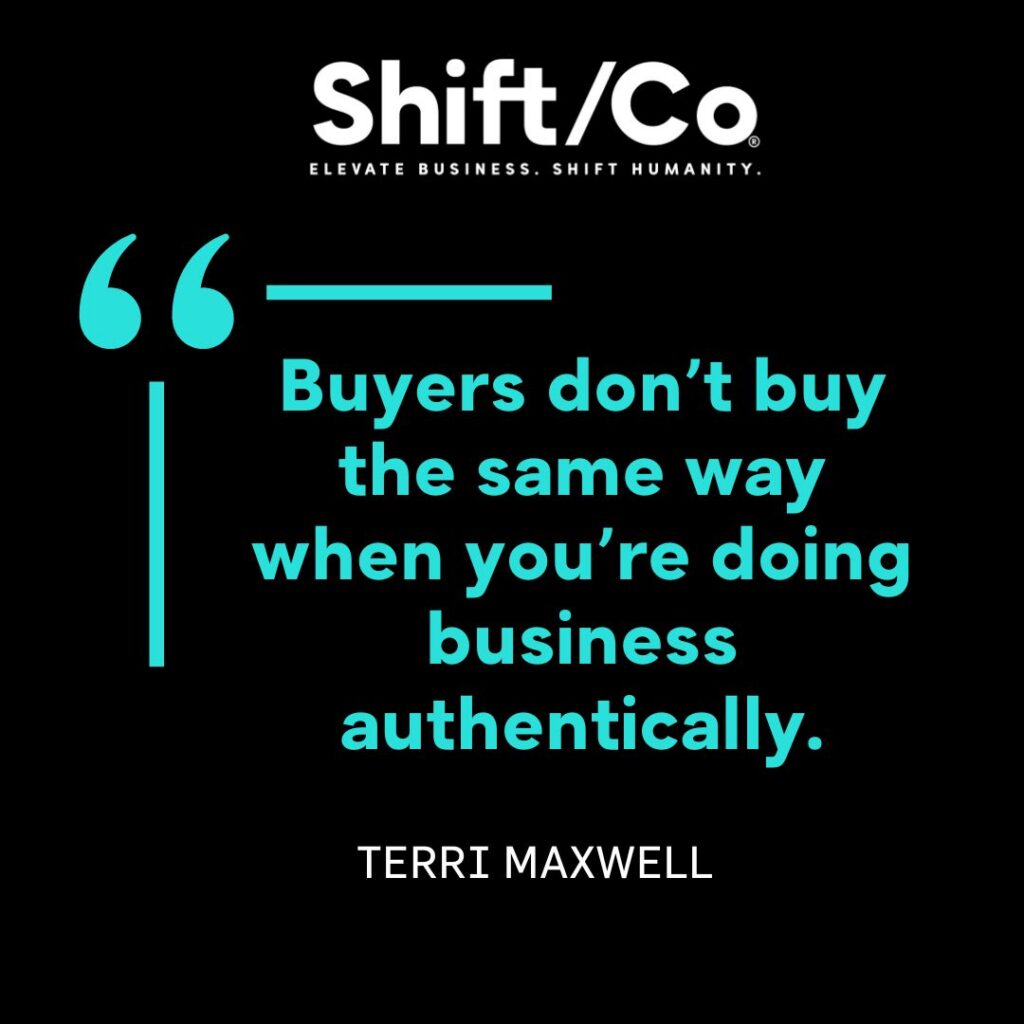
One of the most important distinctions Terri Maxwell, Shift/Co CEO, makes is this:
“Buyers don’t buy the same way when you’re doing business authentically.”
That observation alone explains a great deal of founder frustration.
Conscious buyers are not resistant to spending money. In fact, many are deeply committed to supporting work that aligns with their values. What’s different is how they evaluate trust and intent. They are far more attuned to ‘how’ something is being offered, not just ‘what’ is being offered.
Terri describes this shift very plainly:
“They can smell it. They can smell a lead magnet. They can smell when they’re in a funnel.”
Tactics that once felt standard now feel intrusive. Scarcity tactics that once created urgency now register as pressure. Over-polished messaging feels performative. Automated persuasion creates distance rather than trust. Instead of feeling guided, buyers feel handled. As a result, buyers disengage early because something about the interaction feels off.
This isn’t about being overly sensitive or “anti-sales.” It’s about discernment. Conscious business attracts buyers who pay close attention to alignment, integrity, and intent. When selling methods don’t match those values, resistance shows up quickly.
Many founders say things like:
- “People are interested, but they don’t commit.”
- “I’m having conversations, but they don’t go anywhere.”
- “It feels like I’m explaining myself more than I should.”
For founders, this often creates confusion. The instinct is to try harder or assume they’re doing something wrong. In reality, the issue is that the mechanics of selling haven’t evolved alongside the business.
Why Traditional Sales Tactics Create Resistance in Conscious Business
Understandably, the instinctive response to slowing growth is to double down on tactics. More emails. More funnels. More urgency. More persuasion.
But in a conscious business, this often backfires.
The issue isn’t that these tools are inherently wrong. It’s that most traditional sales systems were designed for a different kind of buyer, one who expects to be pushed, persuaded, or nudged into a decision. Conscious buyers operate differently. They are actively evaluating intent, not just offers.
In conscious business, resistance often isn’t about price or timing. It’s about congruence. When the way something is being sold doesn’t match the values behind the work, buyers disengage quietly. They don’t argue. They simply opt out.
This creates a dangerous misunderstanding for founders. It can feel like proof that selling itself is the problem, when in reality, it’s the method of selling that’s misaligned.
The solution isn’t to sell less. It’s to sell differently.
What Authentic Selling Actually Looks Like in Conscious Business
In conscious business, selling works when it is rooted in clarity rather than persuasion. Instead of trying to convince someone to care, authentic selling focuses on making the value unmistakably clear to the people who already do.
Terri Maxwell is direct about this distinction:
“People don’t buy your purpose. They buy the solution to their problem.”
This is often uncomfortable for conscious founders to hear, not because it isn’t true, but because it requires translating meaning into something tangible. Purpose fuels the work, but it doesn’t automatically communicate relevance. Buyers still need to understand what changes for them, why it matters now, and how the work supports a real need in their lives or businesses.
Authentic selling starts by shifting the focus away from persuasion and toward service. That means spending less time explaining why the mission matters and more time articulating how the work helps. It means naming problems clearly instead of softening them out of fear of being too direct. And it means trusting that clarity is not coercion.
In practice, this kind of selling feels simpler, but it demands discipline. Messages are tighter. Offers are clearer. Conversations are grounded in reality rather than aspiration alone. Instead of leading with inspiration, the work leads with relevance.
This is also where many founders notice a shift in their own energy. Selling stops feeling like a performance and starts feeling like an extension of the work itself. When value is clear and intent is clean, there’s less need to push. The right buyers recognize themselves in the conversation and move forward without pressure.
Authentic selling doesn’t remove effort from growth. It removes friction.
Why This Shift Feels So Uncomfortable for Founders
Even when founders understand why selling has to change, actually making that shift can feel unsettling.
For many conscious entrepreneurs, the old rules provided a kind of structure. Funnels told you what to do next. Scripts told you what to say. Metrics told you whether it was working. Letting go of those familiar systems can feel like losing solid ground, even when those systems no longer fit.
There’s also an identity component at play.
Selling differently often requires founders to be more visible, more precise, and more honest about the value they provide. That can surface doubts that were easier to avoid when growth relied on tactics rather than presence. Questions like: Am I being clear enough? Am I allowed to charge this? Do I trust my own authority? Do I really believe in my product? aren’t theoretical, they show up in real conversations with real buyers.
Terri often points out that discomfort here doesn’t mean something is wrong. It means the founder is being asked to grow alongside the business. When selling becomes relational instead of procedural, it requires confidence, boundaries, and clarity—skills that can’t be outsourced to a system.
This is why many founders stall at this stage. Not because they don’t believe in their work, but because stepping into authentic selling removes the buffer. There’s no script to hide behind. No funnel to carry the emotional weight. The work asks the founder to show up more fully.
What’s important to understand is that this discomfort is not a sign to stop. It’s a signal that the business is asking for a higher level of leadership. Growth in a conscious business doesn’t just expand the company, it stretches the person building it.
And that stretch, while uncomfortable, is also where alignment deepens.

Authentic Selling Requires Focus, Not More Effort
One of the most common mistakes founders make at this stage is assuming that selling differently means doing more. More content. More conversations. More activity.
In reality, authentic selling in a conscious business requires the opposite: focus.
Without the structure of traditional funnels and campaigns, it becomes easy to mistake motion for progress. Founders stay busy, posting, tweaking, experimenting, but the business doesn’t actually move forward in a meaningful way. Energy gets spread thin, and selling starts to feel draining again.
As Terri Maxwell says, “Most entrepreneurs are in motion, not making moves.”
The difference matters. Motion looks like activity without intention. Moves are deliberate actions tied to a clear outcome. In conscious business, growth comes from knowing which actions matter now and having the discipline to let the rest wait.
Authentic selling works when founders are clear about three things: who they are serving, what problem they are solving, and what decision they are inviting the buyer to make. When any of those are vague, selling becomes exhausting.
Focus also creates consistency, which conscious buyers pay attention to. They are less influenced by campaigns and far more influenced by coherence over time. Repeated clarity builds trust. Repeated relevance builds demand.
Why Conscious Business Growth Isn’t Meant to Happen Alone
Selling differently is difficult to sustain in isolation.
When you’re building a conscious business, there are fewer external benchmarks to follow. You can’t always rely on industry norms, templated strategies, or borrowed scripts to tell you whether you’re doing it “right.” Much of the work requires discernment—understanding what resonates with your buyers, what feels aligned for you, and what actually moves the business forward.
That kind of clarity is hard to generate on your own.
Community plays a critical role here, not as motivation, but as feedback. Being in conversation with other entrepreneurs who are navigating the same shifts helps normalize the experience. It creates perspective. It shortens the amount of time founders spend second-guessing themselves or mistaking misalignment for failure.
In conscious business, growth accelerates when founders have space to test ideas, reflect honestly, and receive input from people who understand the nuances of selling with integrity. This kind of support doesn’t replace responsibility; it reinforces it.
The larger point is this: conscious business growth isn’t harder because something is wrong. It’s harder because it asks for a higher level of alignment between values, behavior, and leadership. Selling has to evolve alongside the business. When it does, growth stops feeling like a compromise and starts feeling like a natural extension of the work.
And when selling is grounded in clarity, focus, and trust, conscious businesses don’t just grow, they grow in a way that lasts.
Many of the principles shared here are inspired by the work of Terri Maxwell, CEO of Shift/Co, drawing from over two decades of business growth and leadership experience.
Shift/Co is a global community dedicated to conscious business growth. We empower entrepreneurs to grow their businesses through innovative tools, expert coaching and mentoring, and a supportive network. Our comprehensive approach includes personalized training, leadership development, and a collaborative environment, ensuring that members can achieve significant business growth while positively impacting the world. Join Shift/Co to elevate your business and be part of a movement that believes in doing good business better.
Why Buyers Don’t Buy the Same Way in Conscious Business
Why Progress Feels Hard for the Conscious Entrepreneur (And What to Do About It)
Purpose + Profit: How to Build a Business With a Purpose That Grows
How to Achieve Your Small Business Goals Faster
The Entrepreneurial Mindset: How Focus & Habits Define Successful Founders